RANGE FINDER COTTON TYPE MK II BY E.R. WATTS & SON LONDON WWII "SPECIAL AIR SERVICES" EXCELLENT!!
RANGE FINDER COTTON TYPE MK II E.R. WATTS & SON LONDON WWII with case
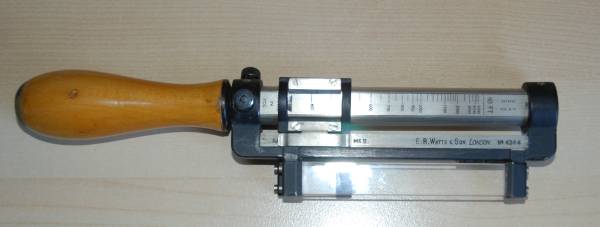
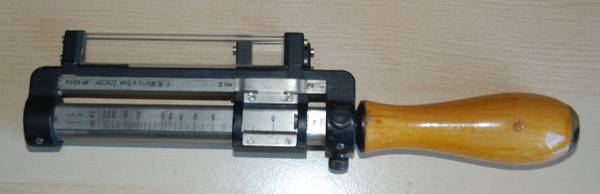
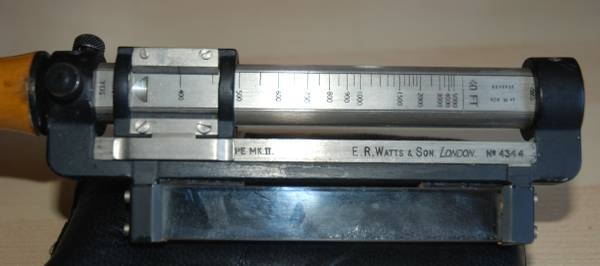
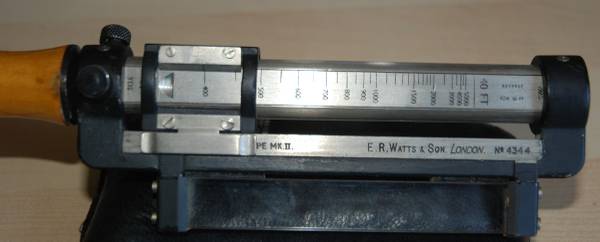
Marked "RANGE FINDER COTTON TYPE MK II E. R. WATTS & SON, LONDON No 4344".
Also, imprinted onto the wood handle is the original WWII SAS logo "SAS" with their parachute symbol.
Very rare with the SAS association! See photos.
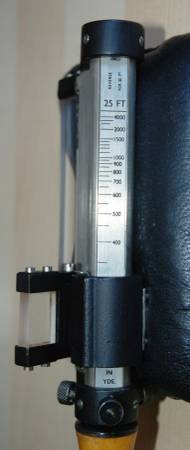
Exceptional original condition with no damage or significant wear. Complete with all parts. All 3 rules slide out perfectly. Scale guide moves across as it should. No rust. Hardwood handle (possibly maple) in excellent condition with original finish. No scratches to glass. Slight wear to black paint from light use. See photos for details.
E.R. Watts & Son, London, Cotton Type Rangefinder
this instrument was used to measure the distance between an object and the observer.
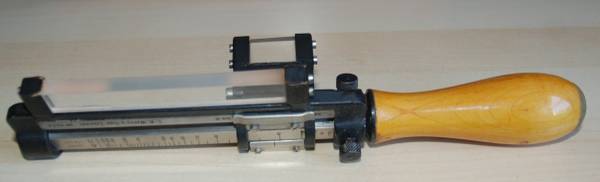
A 4" long linear concave lens (in cross section front and rear of the glass are parallel) is fixed to the base. A prism is mounted on a carriage with an index mark that slides back and forth along the axis of the instrument. When at infinity the slanted side of the prism is parallel to the corresponding part of the concave lens and cancels out any light breaking.
The distance to an object can be measured when the height (or width) of it is known. The carriage is slid until both ends of the object coincide
The E.R. Watts & Son, London, Cotton Type Rangefinder.
Like the Schick Incorporated stadimeter this instrument was used to measure the distance between an object and the observer.
A 4" long linear concave lens (in cross section front and rear of the glass are parallel) is fixed to the base. A prism is mounted on a carriage with an index mark that slides back and forth along the axis of the instrument. When at infinity the slanted side of the prism is parallel to the corresponding part of the concave lens and cancels out any light breaking.
The distance to an object can be measured when the height (or width) of it is known. The carriage is slid until both ends of the object coincide, similar to the use of the 1943 U.S. Navy stadimeter or sextant.
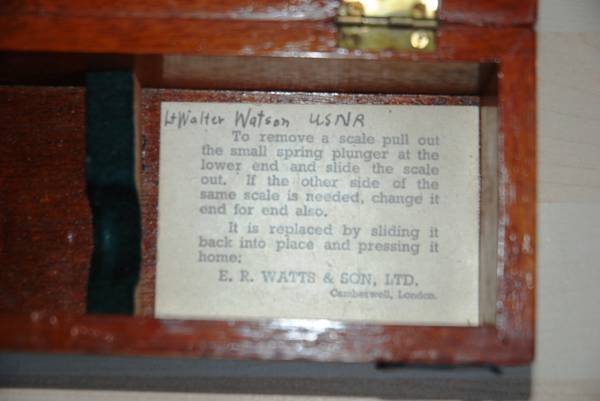
Three reversible brass inserts calibrated on both sides in yards, correspond to various base heights, (20 and 25 feet, 30 and 35 feet and 40 and 50 feet). They are fitted along the axis of the instrument. When the scale for the appropriate base height is selected and inserted, the carriage can be slid for coincidence and the distance read at the index mark on the sliding carriage.